


[tsslogo=250][/tsslogo]
Forensic Science Division Manual
Welcome to the Forensic Science Division Manual
The Forensic Science Division Manual, is, and shall be, a composite of current policies, procedures, rules and guidelines established under previously existing manuals and approved practices within the Forensic Science Division. All personnel within FSD are to conform with the rules and provisions herein contained, by declaring their understanding.
(( This manual will consult both in-character and out-of-character aspects of the Forensic Science Division. Out-of-character portions are clearly marked with double brackets and those of in-character purpose without double brackets. ))
Understanding and Using the FSD Manual
The FSD Manual consists of V (5) volumes (ROMAN NUMERALS) which categorizes and covers all policies, procedures, rules and guidelines. The manual's referencing system enables any particular section of the manual to be, at any time, easily referred to if need be. The format used for referencing is 'Volume.Section.Subsection'. An example of a standard full index reference as follows; '3.1.3' which reads 'three point one point three'.
- The first digit (example, 2.2.3/1) represents the volume number.
- The second digit (example, 2.2.3/1) represents the section number.
- The third digit (example, 2.1.3/1) represents a subsection within a section.
- The fourth digit (example, 2.1.2/1) represents a specific line or paragraph (not shown in Tables of Contents).
Before an officer conducts any of their duties it is mandatory for them to state that they have read the manual which can be found in the Declaration Form topic (here).
The contents of this manual have been reviewed and passed by the Detectives Bureau Staff.
 ........[tsslogo=250][/tsslogo]
LOS SANTOS POLICE DEPARTMENT
FSD MANUAL
Table of Contents
FSD MANUAL
Table of Contents
MISSION STATEMENT
VOLUME I - RULES AND REGULATIONS
- 1.1 - FSD Rules and Regulations
- ((1.2 - OOC Division Rules and Regulations))
- 2.1 - FSD Organisation & Structure
- 2.2 - FSD Rank Authority
- 3.1 - FSD Fleet
- 3.2 - Equipment Available
- 3.3 - Uniforms
- 3.4 - Lab Equipment
- 3.4.1 - Lab Safety & Uses
- 4.1 - Crime Scene Reports
- 4.2 - Lab Analysis
- 4.3 - Firearms & Ballistics
- 5.1 - Firearm and Ammunition Basics
- 5.2 - Firearm Tracing
- 5.3 - Fingerprints & Serial Number recovery
- 5.3.1 - Fingerprint Recovery
- 5.3.2 - Serial Number Recovery
- 5.4 - Bullet Examiniation
........[tsslogo=250][/tsslogo]MISSION STATEMENT
The Area Detective Division a dedicated generalist investigative division of the Detective Bureau of the LSPD. They offer a generalized resource to the Department through the professional fielding of expert investigative staff.
The Forensic Science Division is a investigative section within the Detective Bureau of the LSPD. This offers the chance to civilians to assist with overall investigations when it comes to Crime Scenes and Cyber Crime. The staff is overall held to a high standard and is expected to remain professional at all times.
The mission of the Area Detective Division is to enhance the departments efforts in crime scene investigations, and criminal acts over cyberspace. The FSD also works with officers every day to train and qualify them for the DRE and CSI qualification.
The duties of the Forensic Science Division include, but are not limited to:
- To provide enhanced utility and support to officers in the form of investigative expertise
- To assist the Detective's Bureau with overall Crime Scene Investigation
- To assist the Detective's Bureau with overall Cyber Crime
- To provide dedicated investigative specialist staff to incidents requiring them.
........[tsslogo=250][/tsslogo]VOLUME I
RULES AND REGULATIONS
Volume I, RULES AND REGULATIONS, provides set procedures that must be followed when you are a part of the Forensic Science Division Staff.
1.1- FSD RULES AND REGULATIONS
- All FSD Staff are strongly recommended to get a psychological evaluation. It is strongly advised that these should be taken at bi-monthly intervals following recruitment following the initial assessment.
- FSD Staff are expected to maintain CPR (Courtesy, Professionalism, and Respect) at all times.
- All equipment, uniforms, and fleet must be maintained constantly.
- Crime Scene Investigators will come in contact with death, blood, and possible danger. At all times an Officer must be present when conducting duties outside of the LSPD designated stations. Non-hostile environment investigations may be conducted with a present Criminalist II+ (i.e if a case permits returning to a scene of a crime in an area not prone to sudden hostile danger.) -- Must be on callsign 6H11/12 irregardless of circumstance to keep in contact, should danger arise.
- While conducting a Crime Scene Investigation, all procedures and techniques must be followed. Any and all contamination to a crime scene can effect a investigations outcome. Ensure the Chain of Custody is kept.
- FSD Staff must record and document all work while employed at the LSPD. This must be done in a timely manner and cannot exceed 72 hours. Speak with a member of the FSD Command Team should you require a justified extension.
- Must have a Personnel File within Recruitment and Employment Division and the Forensic Science Division.
- May only use the vehicle fleet provided by the LSPD for official purposes only.
- May occupy the call-signs 6H11 and 6H12 when conducting CSI duties.
- All Staff within the Forensic Science Division are to maintain a high standard of Roleplay. This will be watched closely and assured at all times. Failure to maintain a high level will be forwarded to RED for review and may result in removal from the Department.
- All information noted and discussed within the Detectives Bureau and Recruitment and Employment Division are deemed confidential. All information is expected to remain inside their respected sections/divisions. Leaking any information can result in immediate punishment/removal from the faction.
- Members of the Forensic Science Division are expected to adhere to the LSPD's OOC corruption rules, this being section 3.7.1. You may not deliberately commit any felonies unless permission from Legal Faction Management has been granted and the Chief Of Police has been notified.
........[tsslogo=250][/tsslogo]VOLUME II
RANK STRUCTURE & RANK AUTHORITY
Volume II, RANK STRUCTURE & RANK AUTHORITY, provides the employee with understanding of the structure of FSD and the responsibility structured within the section.
2.1 FSD Organization & Structure
- FSD Command
Laboratory Director (Chief Forensic Chemist)- The Laboratory Director of the Forensic Science Division is responsible for all of the staff that act directly under them. The activity and documentation that is assigned under FSD is constantly evaluated by both CFC and ACFC. The Director works constantly with the Detective Bureau's Command to ensure any and all changes are documented and noted.
- Operates the FSD with the ADiC to conduct monthly evaluations of each staff member. This includes constant updating of disciplinary records, documentation reviews, and keeping all areas updated/clean.
- Overall acts as the departmental lead in the forensic and Cyber Crime matters.
Assistant Laboratory Director- Works along side the Director to ensure all activity within the FSD is stable. Also responsible for the staff that act under the DTS and ADiC. The activity and documentation is evaluated and reviewed constantly. Works with the Director and the Detective Bureau Command to ensure any and all changes are documented and noted.
- Assists with the FSD evaluations of each staff member. This includes updating disciplinary records, documentation reviews, and keeping all areas updated/clean.
- Acts as the departmental lead in forensic and Cyber Crime matters under the Director.
Supervising Criminalist- Is responsible for day to day management, supervision and training of FSD staff along with other FSD Command
- May assess work, induct staff and administer training.
- May Operate under 6H30 - Usable Vehicle: FSD Speedo, FSD Scout, FSD Alamo, FSD Truck (Major Scene Vehicle).
- Acts as a subject matter expert on their specialist area of work.
- Assists and conducts other duties at the direction of the DTS and AOIC.
- Is responsible for setting and enforcing standards as well as developing new content with the rest of command.
- FSD Non-Command
Criminalist III- Must accompany Criminalist I's whenever able in order to provide guidance.
- Must check submitted work by Criminalist I and II's to ensure quality control and provide feedback.
- Is considered a senior member within FSD with wider responsibilities in management.
- May train newer members of the team following their induction.
- Must supervise the forensic aspect of crime scenes.
- May Operate under 6H11/12 - Usable Vehicle: FSD Speedo, FSD Scout, FSD Alamo, FSD Truck (Major Scene Vehicle).
- Good standing within FSD with activity requirements met.
- Promotion to Supervising Criminalist is merit-based with discretion of the Chief Forensic Chemist to decide if eligible.
- ((Hourly Salary:)) $$3,000
- ((Weekly Salary)): 60,000 ((DIII))
Criminalist II- Is considered a full Criminalist and may conduct all duties and work alone unless otherwise specified.
- May operate laboratory equipment relating to firearms without supervision.
- May Operate under 6H11/12 - Usable Vehicle: FSD Speedo, FSD Scout, FSD Alamo, FSD Truck (Major Scene Vehicle).
- Good standing within FSD with activity requirements met.
- Eligible for promotion to Criminalist III after at least two (2) consecutive months of service as Criminalist II.
- ((Hourly Salary:)) $2,800
- ((Weekly Salary)): 56,000 ((DII))
2.2 FSD Rank AuthorityCriminalist I- May respond to field calls and request assignment to forensic work requests.
- Should have their submitted paperwork checked by Criminalist III's or Command Team of the FSD.
- May Operate under 6H11/12 - Usable Vehicle: FSD Speedo, FSD Scout.
- Good standing within FSD with activity requirements met.
- In order to pass the probation, Criminalist I is required to have at least seven reports in total made from the following types:
- Serology & DNA Analysis
- Latent Print Analysis (Typically on firearms)
- Trace Evidence Analysis (Gunshot Residue)
- Firearms Analysis
- Crime Scene Investigation Report
- Eligible for promotion to Criminalist II after probation and at least two (2) consecutive months of service as Criminalist I.
- ((Hourly Salary:)) $2,500
- ((Weekly Salary)): 50,000 ((DI))
- FSD are allowed to utilize the given forensic fleet provided by the LSPD. The fleet is to only be utilized in field activity for the Forensic Science Division needs. This falls down to Crime Scenes and transportation of evidence.
- FSD staff are to adhere to the chain of command regarding Forensic Science Division, Crime Scenes, Cyber Crime, and/or Detective Bureau matters.
- Cannot ignore commands/orders given by any police duty supervisor, Detective IIs or Forensic Science Division command member.
........[tsslogo=250][/tsslogo]VOLUME III
EQUIPMENT & FLEET
Volume III, EQUIPMENT & FLEET, showcases the equipment and fleet that is available to the Forensic Science Division and what they're used for.
3.1 FSD Fleet
3.2 Equipment Available
- FSD Alamo ((36785, 36805)) - FSD Field Vehicle
- 隐藏内容:查看
- FSD Scout ((555085)) - FSD Field Vehicle
- 隐藏内容:查看
- FSD Speedo ((510428)) - FSD Field Vehicle
- 隐藏内容:查看
- FSD Utility Truck ((515369)) - FSD Major Scene Vehicle
- 隐藏内容:查看


3.2 Equipment Available
- Crime Scene Investigation Kit: The CSI kit is equipped with up to date equipment that can be found within the CSI Manual here. It contains kits and equipment for the following scenarios: Blood Collection, Fingerprints, Blood Spatter Documentation, and evidence bags.
- Excavation & Evidence Recovery: Within the assigned vehicles, items like cones, brushes, and stakes can be found. These are used to help locate and secure a body found in more rural areas. Cones and plates can be used around more modern scenes. The equipment includes the following: Cones/Markers, Hand Tools(shovels, hammers, chisel, saw, boxcutter, and screwdriver), Metal Detector, Paintbrushes, sifting screens, stakes, string, and weights.
- Impressions - Tire, Foot, and Tool tracks/marks: The equipment that is used to lift tire tracks, foot impressions, and tool markings. These aren't discussed heavily within the CSI manual, however self explanatory. The use of this equipment is for in the case you find markings that may assist in identifying a suspect for an investigation.
- On-Duty Radio: The radio is used for departmental communication. Departmental communication guidelines can be found here. FSD are allowed to utilize the BASE, SIMPLEX and LSPD DB radio frequencies.
- The uniform provided is for when FSD Staff are conducting CSI on a scene. This is required for all cases to reduce any contamination while conducting duties, and identification purposes. The main part of the uniform is the Anti-Contamination suit. It covers the entire body except the face, feet, and hands. The FSD Staff will be provided with boots, nitrile gloves, and a mask to cover the respective areas. You will be fitted for them upon getting the qualification and accepted into the FSD Staff. The suit should be utilized in the event of a hazardous scene (i.e a mass-casualty scene containing a lot of biological hazards). Otherwise, you may utilize the practical work Forensics shirts, raincoats and jackets that is provided along with the rest of your gear upon acceptance.
- When not utilizing the Anti-Contamination suit or casual work uniform, all FSD Staff are expected to maintain a professional look. Business casual is preferred for FSD staff. Whilst working in the laboratory itself, utilization of a lab coat is heavily preferred.
- Male Casual Work Uniform: show
- Male Rough Work Uniform: show
- Male Laboratory Uniform: show
- Male Anti-Contamination Uniform: show
- Female Casual Work Uniform: show
- Female Rough Work Uniform: show
- Female Laboratory Uniform: show
- Female Anti-Contamination Uniform: show


- The Laboratory is used to help Criminalists and Detectives identify key components of evidence. When handling evidence such as Blood/DNA. The equipment provided will assist in matching up results with possible suspects or other casefiles.
- Fingerprint recognition software can be used at the lab in order to match them with the MDC database. The MDC may be accessed by all of the FSD Staff, including Detectives or Uniformed Services within the Detective Bureau. Improper usage of MDC will result in disciplinary action by Command staff. ((Improper usage of MDC and using unauthorized features can and will result in faction punishment with further possible admin punishment.))
- Access Lab Analysis reports can be found here.
- Laboratory equipment are to be properly used and documented within the Lab Analysis report. ((Lab equipment is displayed and spoken about throughout the manual. At all times should these be roleplayed. This can be for passive roleplay or roleplay with other players. Failure to roleplay any laboratory details can result in punishment. Please see the Laboratory roleplay guide for more information.))
3.4.1 Lab Safety & Uses- When using any chemical or disposable item, the used reagents/items should be properly dealt with or disposed of. A clean lab is a safe lab, especially when working with evidence related to cases. Anything left our or improperly disposed of can lead to punishment.
Chemicals will be present within the lab and can be harmful to all. An emergency plan should always be in mind, as well proper disposal of any accidents should be done. Any excess gas or fumes can be vented out with the fume hood. Emergency gas shut off is available. And any spilled acid or bases should be dealt with their retrospective alternatives. Flammable liquids being kept in their own special storage unit.
spacer - Equipment like Fume Hoods, UV lights, Magnets, and DNA recognition software are all available. These are to be used carefully and taken care of. These can require maintenance and cleaning often, sometimes weekly. The procedure of cleaning these must be handled carefully, as the equipment is extremely expensive.
- When using any chemical or disposable item, the used reagents/items should be properly dealt with or disposed of. A clean lab is a safe lab, especially when working with evidence related to cases. Anything left our or improperly disposed of can lead to punishment.
........[tsslogo=250][/tsslogo]VOLUME IV
DOCUMENTATION
Volume IV, DOCUMENTATION, sets forth explanations of how to do proper reports, where to file then, and how to properly document certain reports.
4.1 Crime Scene Reports
- The CSI documentation format can be found here. The documentation here required to have been filled out after finishing an investigation. The documentation will be checked to ensure the quality.
The documentation includes what is believed that happened on scene, who was on scene, and what evidence was overall collected. Photography will be evaluated and checked to ensure all evidence on the scene was properly documented via pictures. Pictures allow investigators to review the scene even after it. These can be essential to a Detective's case, without pictures they can easily mistake key details in their reports.
Please ensure that when composing reports that narratives are kept to the third person. As well as this investigators should also utilize bold when necessary to outline things such as key facts, locations, names and times.
All of the instructions for documentation can be found within the link above. It is self explanatory and will assist any and all FSD staff with their investigations.
- Much like the CSI documentation format, the Laboratory Analysis can be found here. The Lab Analysis form is used to document any CSI conducted while within the LSPD laboratory. This information is to be documented much like the CSI. MDC access to confirm any findings within the process must be operated with DB related staff, or a Criminalist III plus, to ensure use of the system is done correctly. Unauthorized access will result in disciplinary action by Command staff. Usage is logged.
The laboratory results aren't used as often as CSI reports, however can be pertinent to investigations for DNA testing in later cases. Example of this situation can be like DNA provided by a rape kit however no DNA matching it on the MDC. The DNA can be processed at a later date if stored correctly in order to match it at a later time. Laboratory Analysis reports are often utilized in relation to ballistic forensics, and projectile casing matches.
- The investigations of Firearms and Ballistics differs from the rest of CSI. While CSI covers trajectory and Gunfire Residue. The study of ballistics can go further. Here is the section in CSI that covers Firearms and Toolmarks. The documentation behind this will fall under a Laboratory Analysis. The evidence behind it will much be the same.
Knowing your firearms and what can be classified as an illegal firearm will be required. You can update yourself with the SHAFT Act. This covers the overall information behind what is and isn't illegal for a civilian.
........[tsslogo=250][/tsslogo]VOLUME V
FIREARMS & BALLISTICS
Volume V, FIREARMS & BALLISTICS, explains the procedures of understanding and how to process ballistics investigations.
5.1 Firearm and Ammunition Basics
- To start off, before conducting a ballistics investigation, one must understand firearms and ballistics. A standard cartridge has four components to it. There is The Primer, Powder, Bullet, and Cartridge Case. You can take note of the picture here of where they are.
A bullet is placed into a gun and when fired there are multiple mechanisms interactions that occur on the inside. These interactions will cause the bullet to leave the cartridge and leave several traces. These traces are bullet casings, GFR, and as simple as the trajectory that it was fired from.
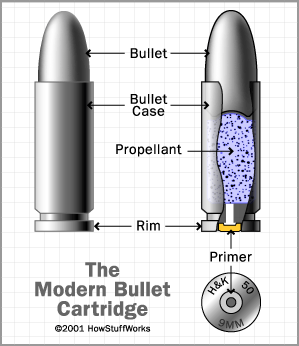
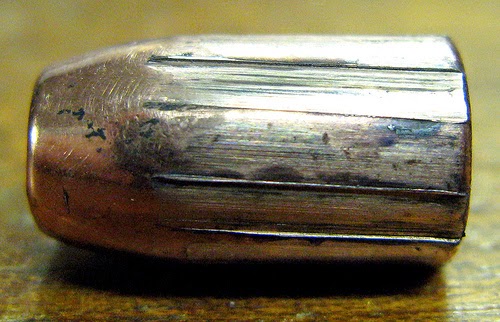
After a bullet has been fired, the casing is ejected from the gun and the primer is left with a dimple on the bottom. As well, there is an ejector mark on the rim for when the casing is thrown out. The bullet is a different story, as it is left with several markings, such as striations.Bullet Striations are often imperfections, microscopic scratches, and land impressions caused by either the gun machinery or how it landed. These can be used to help narrow down what kind of gun was used in a crime. General Striation markings don't help narrow it down to specific guns, however that's where the specifics of microscopic striations come in handy. When collecting a gun used in crime, you can compare the bullet striations to the imperfections given by the gun's barrel.Bullet Striation: show
- Firearm tracing is the act of tracing a firearm since its importation to the country. This includes movement from one person to another, using the imperfections and serial numbers provided. This requires Law Enforcement to gather the weapon and begin the process. Checking all legal documents and using information to track the route it had gone through.
The main purpose of Firearm tracing is to find out how a gun came into the crime scenes. This covers licensed and unlicensed trading of firearms. Tracing a Firearm cannot always succeed. However it can help in the act of determining if it was stolen or not. However, this entire process relies on whether the original salesman keeps documents of their gun sales.
- 5.3.1 Fingerprint Recovery
- The process of lifting a fingerprint from a firearm can be sometimes grueling. This is due to the material it can be made out of or certain methods simply not doing enough. When lifting a fingerprint from a firearm, there is a lab process that can easily do the job.
This is where the fume hood comes to use. A fume hood keeps any harmful chemicals and fumes from reaching someone during a chemical process. When placing a firearm into a fume hood, you'll go through the process of using a superglue substance in a container. You'll heat up the superglue until it is a gaseous state. From there, the fumes in the air will react with the oils left by a finger that was on the gun. That print should start to appear white and not too clear.
The fingerprint can become more enhanced with fingerprint powder, allowing it to become much more noticeable. From there, they are recoverable if successful. However the handle grips are what can cause the process to go wrong and mess up. the textures and other substances always have a chance at ruining the process.
- The process of lifting a fingerprint from a firearm can be sometimes grueling. This is due to the material it can be made out of or certain methods simply not doing enough. When lifting a fingerprint from a firearm, there is a lab process that can easily do the job.
- 5.3.2 Serial Number Recovery
- When recovering a serial number that has been removed or obliterated from a gun, there are two processes. These processes are Magnetic particle inspection and Chemical Restoration. Both can be slow and take some time and results may not be guaranteed, but it's not impossible. These tasks are used to help investigations and figure out where the gun may have come from in the past.
- Magnetic Particle Inspection - The gun will be placed into a small magnetic field. From there, all of the deformities will start to change the field. The irregularity being the serial number. When a ferrous particle solution is added to it, they may become attracted to the irregularity. Shortly after a luminous solution can be added and a UV light can be used to examine the now visible serial number.
- Chemical Restoration - Chemically restoring a serial number isn't always the best option. This requires the serial number to be superficial and able to be brought back to the surface. When applying an acid to the area, the serial number will slowly start to rise up to the top. Most common acid used it Fry's Reagent. The acid is used to remove debris and other substances from the gun and slowly reveal/bring the serial to the surface once again.
- When examining a bullet, there are many characteristics you can look at in order to determine its origin. There are two types of characteristics one can work with one undergoing the examination process. These types are Class Characteristics and Individual Characteristics.
When investigating for Class Characteristics, you are looking for things like lands and grooves, what caliber the bullet is, and rifling twist. These are directly related to how the barrel of the gun affected the bullet. Grooves and lands are created due to imperfections when the gun was created, affecting the bullet. Caliber being the diameter of the barrel, resulting in what type of bullet they are using. And striations/rifling twist are affected by the barrel, either being clockwise or counter clockwise twists.
Individual Characteristics, such as striations require law enforcement to acquire a sample from the gun. This means going into a gun range and firing it. For slower guns such as pistols or revolvers, a water tank can be used. Once the bullet has stopped in the water tank, the bullet can be recovered and examined for similar features. As for high powered guns such as rifles, these are to be used at a controlled range with backing that can stop the bullet.
((Script commands that are required for successful examination of a firearm will be as follows:
/casing testweapon [ID] - Matching a firearm with any casings already submitted to the system. You can find the firearms ID in your inventory by checking it with /invex.
/casing testserial - Matching the firearms serial number with any casings already submitted to the system.
/casing checkevidence [Evidence Bag ID] - Checking the results of a shell casing submission - ID can be found here
/casing myevidence - Your previous casing submissions and their results.
/casing checkserial [casingID] - Checking if a casing matches a serial number of a weapon.
Note: Additionally, to gain more information regarding the results for /casing testweapon [ID], a command /casing testweapon [ID] expand can be used.))
........[tsslogo=250][/tsslogo]VOLUME VI
SEROLOGY
Volume VI, SEROLOGY, explains the procedures of understanding the basics to blood, the types of bloodstains that can occur, injuries that can be sustained that result in such stains and how to process blood collections (Serology).
6.1 Serology Basics

 6.2 Types of Bloodstains / Spatters


6.3 Interpreting Bloodstain Patterns & Bloodstain Events
- Blood contains both liquid (plasma and serum) and solids (red blood cells, white blood cells, platelets and proteins). Blood is in a liquid state when inside the body, and when it exits the body, it does so as a liquid. But as anyone who has had a cut or a scrape knows, it doesn't remain a liquid for long. Except for people with hemophilia, blood will begin to clot within a few minutes, forming a dark, shiny gel-like substance that grows more solid as time progresses. The presence of blood clots in bloodstains can indicate that the incident was prolonged, or that the victim was bleeding for some time after the injury occurred. Blood can leave the body in many different ways, depending on the type of injury inflicted. It can flow, drip, spray, spurt, gush or just ooze from wounds.
Some bloodstains are latent, meaning they cannot be seen with the naked eye. Investigators and Criminalists can use chemical reagents such as Luminol to find and photograph latent bloodstains. When sprayed on blood, Luminol creates a bright blue luminescent glow by reacting with iron in the blood's hemoglobin.
Serology and blood spatter analysis can determine the following in the field;
- Bloodstains are classified into three basic types: passive stains, transfer stains and projected or impact stains. Passive stains include drops, flows and pools, and typically result from gravity acting on an injury. Transfer stains result from objects coming into contact with existing bloodstains and leaving wipes, swipes or pattern transfers behind such as a bloody shoe print or a smear from a body being dragged. Impact stains result from blood projecting through the air and are usually seen as spatter, but may also include gushes, splashes and arterial spurts often caused by gunshot spatter.
Blood spatter is categorized as impact spatter (created when a force is applied to a liquid blood source) or projection spatter (caused by arterial spurting, or spatter cast off an object). The characteristics of blood spatter depend on the speed at which the blood leaves the body and the type of force applied to the source.
6.2.1 Classifications- Gunshot Spatter
- Gunshot spatter includes both forward spatter from the exit wound and back spatter from the entrance wound. Gunshot spatter will vary depending on the caliber of the gun, where the victim is struck, whether the bullet exits the body, distance between the victim and the gun and location of the victim relative to walls, floors and objects. Typically, forward spatter is a fine mist and back spatter is larger and fewer drops.
- Gunshot spatter includes both forward spatter from the exit wound and back spatter from the entrance wound. Gunshot spatter will vary depending on the caliber of the gun, where the victim is struck, whether the bullet exits the body, distance between the victim and the gun and location of the victim relative to walls, floors and objects. Typically, forward spatter is a fine mist and back spatter is larger and fewer drops.
- Cast Off Fig. 1 Below
- Cast-off style spatter results when an object swung in an arc flings blood onto nearby surfaces. This occurs when an assailant swings the bloodstained object back before inflicting another blow. Analysts can tell the direction of the impacting object by the shape of the spatter (tails point in the direction of motion). Counting the arcs can also show the minimum number of blows delivered.
- Arterial Spray
- Arterial Spray refers to the spurt of blood released when a major artery is severed. The blood is propelled out of the breached blood vessel by the pumping of the heart and often forms an arcing pattern consisting of large, individual stains, with a new pattern created for each time the heart pumps.
- Expirated Spatter Fig. 4 Below
- Expirated Spatter is usually caused by blood from an internal injury mixing with air from the lungs being expelled through the nose, mouth or an injury to the airways or lungs. Expirated spatter tends to form a very fine mist due to the pressure exerted by the lungs moving air out of the body. Small air bubbles in the drops of blood are typically found in this type of spatter.
- Void / Ghost Patterns Fig. 2 Below
- While not technically treated as a form of spatter, it does play a major part in many scenes. A void occurs when a person or object blocks the path of the blood. They are important because voids can show criminalists and investigators if objects are missing from the scene, where a person or persons were at the time of the incident, and if a body was moved. An object that leaves a void in one of the above mentioned bloodstain pattern will have a matching bloodstain pattern on its surface, allowing analysts to replace it in the scene if found. Void patterns are most useful for establishing the position of the victim(s) and assailant(s) within the scene.
- Gunshot Spatter
6.3 Interpreting Bloodstain Patterns & Bloodstain Events
- When blood is impacted, droplets are sent through the air. When these droplets strike a surface, the shape of the stain changes depending on the angle of impact, velocity, distance travelled and type of surface impacted. Generally, the stain shape will vary from circular or oval shapes, with tails or spines extending in the direction of travel. Smaller stains may also break away from the initial drop which are referred to as 'satellites' formally. By measuring the width and length of the stain, the angle of impact can be calculated, helping both criminalists and investigators to determine the actions that may have taken place at the scene.
A crime scene where bodily injury has occurred is likely to have some amount of bloodstain evidence present; however, the amount will vary depending on the circumstances of the crime. The type of injury inflicted and the amount of force used will determine the volume and pattern of bloodstains


((As the server does not obviously have as a sophisticated system for blood spatter analysis besides blood-droplets, the information above should try to be collected from those on scene if possible in an OOC manner, so you as a criminalist and/or CSI qualified investigator can determine what just occurred. ))
- Bloodstain samples can be collected for a in-depth laboratory analysis by cutting away stained surfaces or materials, photographing the stains, and drying and packaging stained objects. The tools for collecting bloodstain evidence usually include high-quality cameras (still and video), trajectory devices, sketching materials, cutting instruments and evidence packaging.
Above specialized equipment are reserved for criminalists, however on-site field investigators can still collect stained materials and objects for packaging, as well as still images. Physics and mathematics are essential when it comes to on-site spatter analysis. To find the area of convergence, investigators typically use string to create straight lines through the long axis of individual drops, following the angle of impact along a flat plane, for instance the floor or wall where the drops are found. Following the lines to where they intersect shows investigators where the victim was located when the drops were created.
..
The most frequently used method of capturing bloodstains is high-resolution photography. A scale or ruler is placed next to the bloodstain to provide accurate measurement and photos are taken from every angle. Video and sketches of the scene and the blood stains is often used to provide perspective and further documentation. This is commonly done even if stained materials or objects are collected intact by field investigators.
There are two different types of blood that can be collected at a crime scene: liquid and dried blood. Liquid blood evidence is generally collected from blood pools but can be collected off of clothing as well, using a gauze pad or a sterile cotton cloth. Once the sample is collected it must be refrigerated or frozen and brought to the laboratory as quickly as possible. The sample must first be dried thoroughly at room temperature. It is important to get the sample to the laboratory as quickly as possible because after 48 hours the sample might be useless. If the sample has to be mailed it should be completely air dried before packaging. If the sample isn't completely dry when it needs to be packaged, the sample should be rolled in paper and labeled and then put into either a brown paper bag or a box. The paper bag or box is then sealed and labeled again. It is important to only place one item per container to avoid contamination and samples should not be placed in plastic containers. Samples shouldn't be in plastic containers because if the sample is still damp the moisture from the sample can cause microorganisms that can destroy the evidence. Also, due to this fact, samples should not be in any container for more than two hours.
Dried bloodstains can be found on small objects, larger objects and on clothing. When dried blood is found on a small object the entire object can be sent to the lab after it's been properly packaged and labeled. When dried blood is found on a larger object that is transportable, an investigator should cover the stained area with paper and tape the paper to the object to avoid contamination. If the object that is stained is not transportable there are different ways that an investigator can collect the sample. One option is to cut out the stained area of the large object. If the portion is cut out the sample is packaged the same way as described above but a control sample should also be provided in a separate package. Another option is to use fingerprint tape and lift the sample as well as the surrounding control area. If this method is used it is important for investigators to not touch the sticky side of the tape with bare hands and the investigator should run an eraser or some type of blunt object over the placed tape to ensure that contact is made with the dried stain. The lifted stain is then be packaged and labeled, then delivered to the laboratory. Another way to collect a sample off of an object is to use a clean sharp object to scrape flakes of the stain into a paper packet. The last two methods of collection of a dried bloodstain on a large object require the use of distilled water to dampen the stain before rolling a thread in the stain or absorbing the stain with a cotton square. These two methods are not recommended due to the risk of contamination. When dried blood is found on clothing the entire article of clothing should be packaged and labeled and delivered to the lab.
It is important for the investigator to remember to keep each sample separated so that there is no contamination between samples.
In the laboratory, criminalists determine if it is human blood and then develop a DNA profile. This becomes critical when there are multiple victims. DNA profiling may also indicate whether the perpetrator was injured during the attack, as in the case of two DNA profiles found at a scene with only one known victim.
(( Blood spatter should be roleplayed as above, high-quality photography of the spatter should be documented, and then collected by swabbing small samples of blood or soaking up pooled blood for analysis. Both CSI qualified and criminalists are capable of doing this.
Blood samples can be collected by walking over them and press the interaction key (Y) or by using the command /sampleblood.
Commands for laboratory analysis done by FSD personnel:
/getdnastring [firstname] [lastname] - Use this to check if someone has a sample on record and returns their DNA string + blood type.
/getbloodname [DNA string] - To get the name of the character who's blood the DNA string belongs to.
Reminder: This is OOC information and can only be used for reports in OOC manner. This command is used to double check if the database in game and MDC database is 1:1 correct.
/checkallsamples - Checks all blood samples in your inventory.
/checksample - Check a single blood sample in your inventory.
/cdna - Use this on bodies to get their DNA strings. Useful for eliminating samples.))